Missing From Albany’s Family Relief Tax Break: 1.2 Million NYC Kids

Posted by Doug Turetsky, April 19, 2013

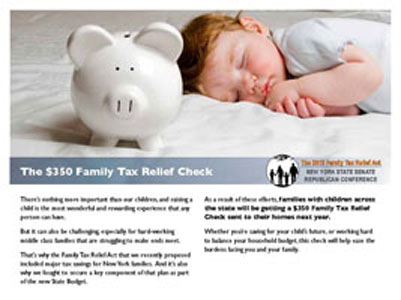
Tucked into the state budget adopted last month is a special three-year tax break for New York families with children. The first of three annual rounds of checks for $350 per qualifying family will be sent out in October 2014 (just weeks before the next year’s gubernatorial and legislative elections) at a cost of about $400 million statewide. While New York City families stand to garner a large share of the checks, many will find their mailboxes empty.

An analysis by IBO’s Michael Jacobs, which uses data from a sample of 2010 income tax returns, finds that about 575,000 of the city’s tax-filing families with children will qualify for the check next year. Each of these families will receive a check for $350, bringing just over $200 million into the city.

But that same analysis also reveals that nearly 725,000 New York City families with children—families with an estimated 1.2 million kids—will receive nothing. That’s because in most instances they earn too little to qualify.

Here’s how the tax break, called Family Tax Relief, works: To qualify, a tax-filing family or household with at least one child needs an income after tax-deductions (adjusted gross income in tax-speak) of between $40,000 and $300,000, and they must have owed New York at least a $1 on their 2013 state income taxes. If the family qualifies, they’ll get a check for $350, regardless of whether they have one child or a dozen under the age of 17, and even if the amount they owed is far less than the $350 check they’ll receive.
pg3

Family Tax Relief is described as help for “middle class families that are struggling to make ends meet” Yet in a city where the median adjusted gross income for families with children is $38,400, Family Tax Relief’s definition of middle-class is high and wide of the mark. As a result, tens of thousands of relatively well-off New York families will get a check while many low, moderate, and middle-income families with children will not.

To put that observation into numbers: more than 190,000 New York City families with children and adjusted gross incomes from $100,000 to $300,000 will be receiving checks worth more than $66 million combined. But roughly 660,000 families with adjusted gross incomes under $40,000 will find their mailbox empty. Among those left out are about 126,000 families—most of them single mothers with children—with incomes below $40,000 but who still owe income tax to New York State.

IBO’s Julie Anna Golebiewski estimates that about 60 percent of all the households with children in the Bronx will not qualify for the credit, based on data from the American Community Survey. In nearly all cases, the households won’t qualify because their incomes are too low. In Staten Island, about 28 percent of households with children won’t qualify and in Queens about 36 percent. In Brooklyn and Manhattan, roughly half of all households with children are expected to get a check. About 16 percent of Manhattan households with children won’t get a check because their incomes are too high, giving Manhattan the largest share of over-the-limit earners among the five boroughs.

New York’s Family Tax Relief bears some similarity to a 1991 proposal by former New Jersey Senator Bill Bradley to provide a $350 tax credit to families in the U.S. for each of their children. But Bradley’s plan called for the program to be universal, with everyone regardless of income getting help. If a family was too poor to owe taxes they would get the benefit in the form of a direct payment rather than a tax credit.

IBO’s Jacobs calculates that making the New York State program universal so that it covers all families with children—regardless of their income level or state tax liability—would more than double the cost of the program in New York City to about $453 million in 2014, even if the checks are capped at $350 a family no matter the number of children. Alternatively, if Albany were to let those single mothers and other families with incomes below $40,000 qualify for relief while maintaining the requirement that families have some tax liability, it would raise the total cost to the state of the Family Tax Relief program in New York City to roughly $245 million—about $45 million more than under the current legislation.

The City’s Easiest Savings

Posted by Doug Turetsky, April 12, 2013

Over the past few years, one of the biggest sources of city budget savings has come without any effect on municipal services. It’s involved no reduction in staffing. No cutback in program operations or number of New Yorkers served. The savings has come from debt service, the interest and principal the city pays on the money it borrows to build schools, fix roads, buy fire trucks, and the like.

Record low interest rates over the past few years have enabled the Bloomberg Administration to save a bundle. The cost to the city on money borrowed through variable-rate bonds has been relatively low, and the city also has been able to refinance some existing fixed-rate debt at lower interest rates than when those bonds were first issued. In IBO’s report on the Preliminary Budget for 2013, we estimated that the city had recognized $875 million in savings just on its variable-rate general obligation debt (the city also borrows large sums through an entity called TFA) due to lower than forecast interest rates in fiscal years 2010 through 2013.

Besides the $875 million in savings, there are two additional terms to focus on in that last sentence: “recognized” and “forecast.” When and how the Bloomberg Administration has been building these savings into the city budget is worth a closer look.

Take the city’s current budget plan, for example. The Mayor’s plan assumes interest rates on variable- rate general obligation bonds will be 2.45 percent through the rest of this fiscal year, which ends in June. In fact, as IBO’s Sean Campion points out, interest rates on these bonds (based on a Securities Industry and Financial Markets Association index) have been below 0.50 percent—about one-fifth of City Hall’s forecast—since April 2009.

And the Bloomberg Administration projection for this interest rate in fiscal year 2014? Try 4.15 percent. Yet there’s no indication this rate is poised to rise and the Federal Reserve has made clear its intention to keep interest rates low, at least in the near term.

While some might see the Bloomberg Administration’s interest rate projections as fiscal prudence others might view it as a bit of forecast sleight-of-hand.

Last month in IBO’s report on the Preliminary Budget for 2014, Campion estimated that if the city lowered its interest rate assumption for the rest of the fiscal year to a still-above-market-rate 0.30 percent for variable-rate bonds and issued no more of this debt in the remaining months of this fiscal year, debt service spending in 2013 would be $148 million less than currently projected. That savings won’t be recognized until late in this year’s budget cycle and will likely become part of the end-of-year surplus.

One way to look at these savings is as a cushion in case some revenue source comes in lower than expected, or some form of spending such as shelter costs for the homeless winds up costing more than budgeted. Having this type of savings tucked away in the budget plan can fill a last minute shortfall, although the city maintains a general reserve for just this purpose.

But another way to think about it is $148 million that could have been used elsewhere in this year’s budget. The considerably higher than likely projections of debt service enable the Mayor to “park” money out of sight and out of mind of Council Members and other elected officials who might want to use those funds for new or existing programs. With the much higher than likely forecast for interest rates in 2014, the amount of money that could be “freed up” in next year’s budget by a projection closer to recent trends would be even more substantial.

Despite the record low interest rates and the savings they ultimately produce in the budget, overall debt service spending under the Mayor’s budget plan continues to be one of the city’s fastest growing expenditures. Spending on debt service is projected to increase $1.7 billion from this year through 2017 (adjusted for the use of the 2012 surplus to prepay some of the 2013 cost), when debt service expenditures are expected to total $7.7 billion.

But if past is prologue, debt service costs will not grow by as much as in the budget plan. Still, costs will grow largely because of the plan for more borrowing. The Bloomberg Administration expects that the city’s total outstanding debt will grow from $68 billion this year to nearly $75 billion in 2017.