State Cuts to the Court System Likely to Carry a Price Tag for the City

Posted by Bernard O’Brien, July 27, 2011

New York State’s budget for this year includes $170 million in savings from cuts to the Office of Court Administration, which has already resulted in the layoff of more than 400 state court system employees, or about 2.5 percent of the system’s workforce statewide. But savings realized by the state from these cuts could mean millions of dollars in additional costs to New York City if the pace of processing criminal cases slows. That’s because people under arrest may be spending longer periods awaiting trial in the city’s jails—additional jail time that will largely be funded by the city.

The likelihood of slower court processing is almost certain. As state Chief Administrative Judge Ann Pfau told the New York Times, “Delays are going to be more built into everything we do, unfortunately….If you are waiting for a trial, the trial that is ahead of you is going to take longer.”

Much of the fiscal effect on the city would show up in the Department of Correction’s budget. More than 70 percent of inmates in city jails on Rikers Island and in borough-based facilities at any given time are detainees, meaning they are being held pending disposition of the criminal charges they are facing. The pace of criminal case processing in the courts is therefore a major determinant of the cost of running the city’s jail system, where the department’s total cost of incarcerating each inmate averages $387 per day.

For those inmates convicted of serious crimes and sentenced to time in the state prison system, the time they will actually spend in state prison (at the state’s expense) is reduced by the amount of time already spent in city custody prior to conviction and sentencing (almost entirely at the city’s expense). So that means the longer prisoners remain in city custody during adjudication of their cases, the larger the city’s—and the smaller the state’s—share of total imprisonment costs.

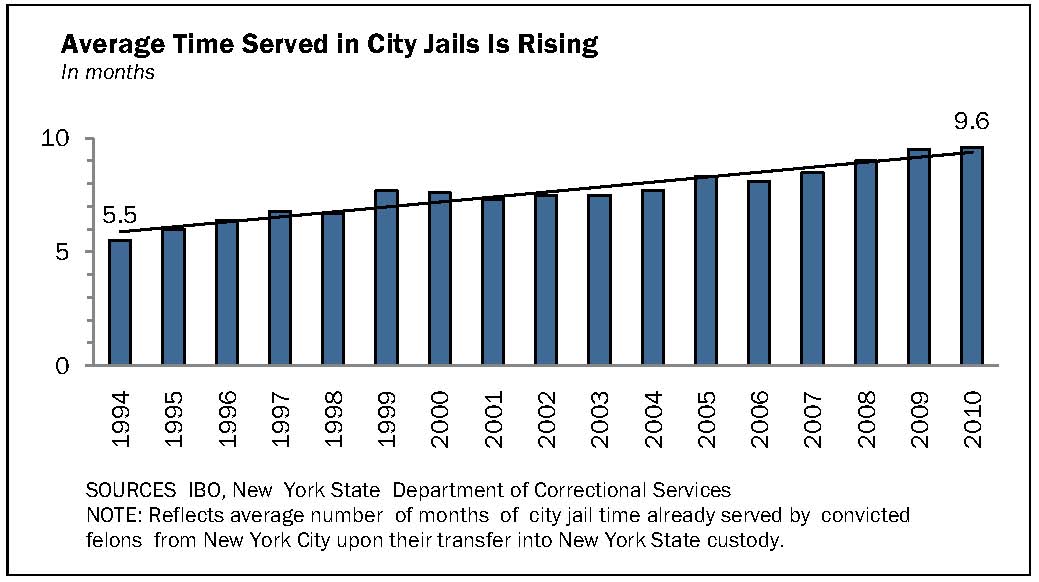
As reflected by the trend line in the graph below, the average amount of city jail time deducted from the state prison sentences of convicted felons from the city has already been moving upward in recent years, rising from 5.5 months in 1994 to 9.6 months in 2010. This trend is consistent with the slower pace of deciding some cases in recent years. While the Office of Court Administration’s own standards call for felony cases to be decided within six months from the date of filing, the percentage of felony dispositions in the city failing to meet that standard grew from 23 percent in 1994 to 37 percent in 2010.

Increases in jail time translate into additional city costs. For example, if slowdowns in case processing result in another month being added to the average time state prison-bound inmates spend in city jails, IBO estimates that the city would incur about $15 million in additional annual expenses at the Department of Correction. In addition, longer periods of incarceration for the thousands of detainees held temporarily in city jails each year but not ultimately destined for state prison—those held on misdemeanor charges, alleged felons ultimately acquitted, etc.—would also result in additional corrections costs borne by the city.
Besides potential increases in corrections department costs, the hit to the city’s budget from delays in criminal case processing could show up in other places as well. For example, police overtime expenditures could be driven up if cutbacks in court staff result in a longer arraignment process, with police officers spending additional time processing arrests. According to a number of recent press accounts, the time from arrest to arraignment has already increased.

So when it comes to cutbacks to the court system to help close the state’s budget shortfall, some of Albany’s savings may come at New York City’s expense.

City’s Multitude of Property Tax Exemptions Add Up to a Wealth of Revenue Foregone

Posted by Doug Turetsky, July 15, 2011

In one respect New York City is much like most other cities and towns across the country: the property tax is by far the biggest source of tax revenue. For 2012, the fiscal year that began two weeks ago, the property tax is expected to bring in $17.6 billion, about 42 percent of all the tax revenue the Bloomberg Administration expects to collect this year. But it could be more, a lot more, if not for the slew of tax exemptions doled out —$13.5 billion worth in 2012 based on an analysis of the city’s property tax roll for this year by IBO’s Ana Champeny.

That’s $1 billion more than the $12.5 billion in property tax breaks the finance department estimated for 2010. Some of the breaks are permanent and may actually be worth more than estimated by either IBO or the finance department.

Many of these exemptions are permanent; for example, the U.S. Supreme Court ruled in McCulloch v. Maryland (1819) that the Constitution exempts the federal government from state taxation. Because so many exemptions are permanent, there’s not much incentive for the city to invest in more accurate assessments. But it’s still instructive to have a handle on how much the city loses to all the various exemptions, some imposed from above and others granted more locally.

The biggest beneficiary is government itself: city, state, and federal as well as government-related entities such as the Metropolitan Transportation Authority and the New York City Housing Authority. New York City government holds more than 7,500 properties with a tax value of nearly $5.0 billion. The city will forgo $751.4 million in taxes on properties held by the transportation authority. Albany and Washington control properties with a tax value of $700.7 million that goes unpaid. Foreign governments also get a free ride that will cost the city $74.2 million this year on 311 properties.

The second largest beneficiaries of property tax exemptions in terms of tax dollars forgone are institutions, which range from cemeteries to private schools and colleges to churches, synagogues, and mosques. Together these institutions are exempt from paying $2.0 billion in property tax this year.

Among these institutional beneficiaries, houses of worship saved the most. This year, more than 9,500 churches, synagogues, and mosques will get a pass on $626.9 million in property taxes. About 40 percent of the religious institutions qualifying for the exemption are located in Brooklyn, long known as “the borough of churches.” But the sobriquet comes with a price tag of $186.2 million in forgone property tax. Manhattan may be far less spiritual in terms of the number of exemptions for houses of worship, but because of higher property values they come at a greater cost than in Brooklyn. Roughly 1,200 religious institutions in Manhattan will not be burdened by bills for $198.2 million in property tax.

Hospitals, medical clinics, and other health care facilities located in the city are also substantial beneficiaries of property tax exemptions, with the city foregoing $515.5 million in 2012 property taxes. Private elementary and secondary schools and colleges and universities are exempted from paying $430.2 million in property tax (for fuller discussion of the college and university exemption, see IBO’s Budget Options for New York City).

Other institutions benefitting from the property tax exemption are foundations and charitable organizations as well as many cultural organizations. Foregone property taxes will save charities $218.2 million and cultural organizations $103.5 million this year.
The city also provides property tax exemptions through about two dozen different programs to encourage construction or renovation of residential buildings, foster commercial development, or assist individual New Yorkers such as veterans or senior citizen homeowners. Some are targeted to very specific sites such as the exemption for Madison Square Garden ($15.1 million in 2012). Conversely, this year, more than 21,000 properties enjoy $168.6 million in J-51 tax exemptions to spur residential renovations.

As a New York Times article recently noted, cities and towns across the country are taking second looks at some of the tax exemptions they’ve granted. Some are focusing on “eds and meds,” seeking to negotiate voluntary payments or an increase in payments in lieu of the full property tax, often referred to as PILOTS. As New York City grapples with its own ongoing budget shortfalls, local policymakers may feel the need to reassess some local tax breaks as well.